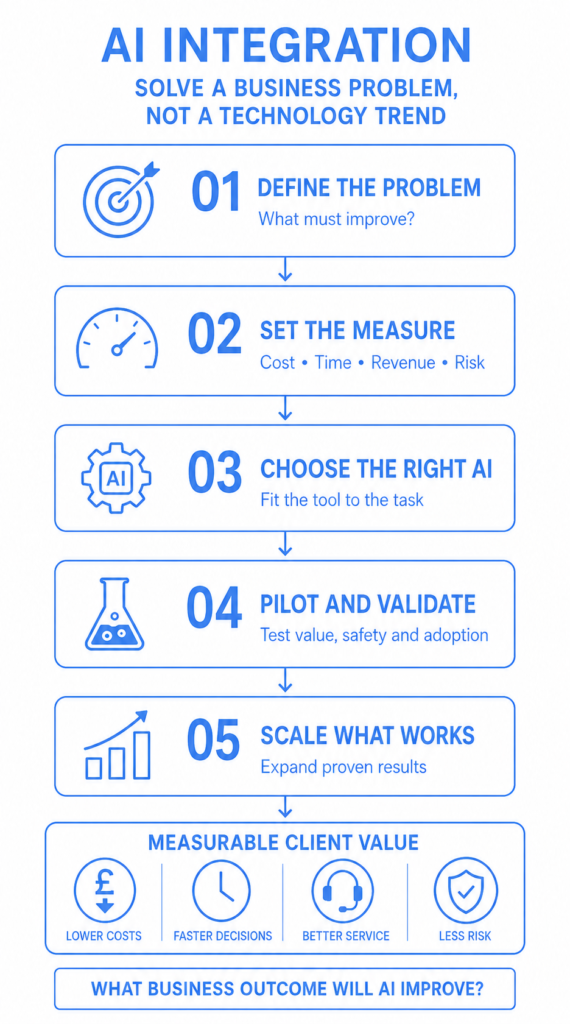
AI integration: solve a business problem, not a technology trend
AI can support customer service, document processing, forecasting, marketing personalisation, knowledge retrieval, quality control and administrative work. The correct starting point is a valuable and repeatable use case.
Stellmont Group recommends evaluating each AI opportunity against five tests:
Value: Will it increase revenue, reduce cost, improve quality or lower risk?
Data: Is the necessary information accurate, lawful and accessible?
Workflow: How will the tool fit into the existing process?
Control: Where is human review required?
Adoption: Do employees understand when and how to use it?
The ONS reports that improving business operations is the most common purpose for AI use. Yet adoption remains relatively shallow, which means competitive advantage is more likely to come from disciplined implementation than from access to the technology itself (Office for National Statistics, 2026a).
Start with one controlled pilot, establish a baseline, train the users and measure the result. Scale only after the pilot demonstrates value and the risks are understood.
What to measure: hours saved, cost per transaction, response time, accuracy, adoption rate, customer satisfaction and return on investment.